8/08/2012

People to People Student Ambassador in Aomori - 02

On the third day of their stay in Aomori Prefecture, they visited Inakadate Village, neighboring village to Hirakawa, to see paddy field art.

Five kinds of rice with different leaf of colors, green, red, yellow, white and purple, are used to compose this art.

These are the first arts which can be viewed from the observatory at Inakadate Village Office. This art is in the motif of the Goddess of mercy and the God of Fire.
*There's a live camera at the observatory.
http://121.119.144.160:60019/viewer/live/ja/live.html


The second art, at the Roadside Station Inakadate, shows Seven Gods of Good Fortune on the Kitamaebune (northern-bound cargo ships sailed from Osaka to Aomori during Edo and Meiji Periods). The students formed human letters saying P2P (People to People) in front of the art.


They left Inakadate for Hirosaki, and what they did first in Hirosaki was to make hand-rolled sushi for lunch, and here’s what they made using rice, dried seaweed, mashed and seasoned fish (pink stuff), carrot and spinach.


After having sushi for lunch, they visited “Neputa Mura (Village)”. Neputa Festival is one of the four big summer festivals in Aomori Prefecture. This village is a museum about the festival and also where playing the shamisen can be experienced.

The students got a lecture on playing the shamisen by the national champion of 2011, and after practicing about 40 minutes, they mastered a Japanese song “Sakura”.


After experienced new and old musical instrument, they took part in a quiz rally in Hirosaki Park. They were to answer the questions on Hirosaki such as “How old is the oldest cherry tree in the park?”, “Which city (out of Portland, New York, Los Angeles) is the same latitude as Hirosaki?”.

Hirosaki Castle and a mascot character of Hirosaki  "Takamaru-kun"

The last visit of the day was Chosho-ji Temple in Zenringai.
Chosho-ji is a temple with Bodhisattvas built for Tsugaru Lords. Its Sanmon (main gate), standing 16.2 meters high, was built by the 2nd Lord Nobuhira in 1629. Sanmon is a teaching in Zen Buddhism signifying 'Sangedatsumon' (gate of the three liberation). There are 33 Zen temples along the Zenringai path, with the Zenringai area being designated a national important cultural property.


This article continues to 03.

Aomori Sightseeing Guide "aptinet": http://en.aptinet.jp/

8/03/2012

People to People Student Ambassador in Aomori - 01

We had 22 students from the U.S. by People to People Ambassador Program. They spent 5 days in Aomori Prefecture, and experienced heaps of things.

They first visited Hirakawa City where they stayed with Japanese host families. Before they met their host families, they walked around the town viewing old style houses, gardens and warehouses.


On the second day, they enjoyed farming with their host families. They picked various vegetables, mowing the orchard and disbudded of grapes. (I didn’t accompany them on this day.)

Here’s the bulletin sent to my office from Onoe Warehouse Promotion Committee for Preservation, Utilization and Application, the host organization of farm staying. They show photos of farming and of the farewell on the last day in Hirakawa.


The next day, they would go to see the paddy field art in Inakadate Village.

This article continues to 02.

Aomori Sightseeing Guide "aptinet":  http://en.aptinet.jp/

7/26/2012

Grazing Horses

In Shiriyazaki (Cape Shiriya), located at the eastern-tip of Shimokita Peninsula, Aomori Prefecture, there’re about 30 grazing horses called “Kandachime”. “Kan” means cold weather, “dachi” means standing and “me” means horse.

Red sign indicates Shiriyazaki.


Horses and Shiriya Lighthouse

Those horses used to hold an important position in farming that people preferred their physical strength and patience against cold weather and poor food, and also their sustaining power and obedient character were preferable.

They stay in Shiriyazaki from May to October, and in winter time, from November to April, they spend winter months in the wintering field called “Ataka”, 2.5 km south from Shiriyazaki.

Platinum blond?

This colt was born in May.

Very gentle

Twins
Kandachime and Shiriyazaki are designated as Natural Treasure of Aomori Prefecture.

Transportation: get on Shimokita Kotsu Bus (Shiriya Line) at Mutsu Bus 
                      Terminal, and get off at Shiriyazaki (1 hour), and approx.
                      20-minute walk to the lighthouse.


Aomori Sightseeing Guide "aptinet":  http://en.aptinet.jp/

6/19/2012

"Nokkedon" - Seafood Bowl of Your Own Taste

I said Aomori is famous for apples and namaco (sea cucumber) in the previous posts, and this time, I recommend fresh seafood caught along the coast of Aomori.

"Nokke" means "dish up" and "don (donburi)" means bowl, and at "Aomori Gyosai Center (= Aomori fish and vegetable market)", you can get your original seafood bowl which can definitely be cheaper than the one at sushi restaurants.


This is Aomori Gyosai Center in Furukawa, Aomori-City, located only several-minute walk from Aomori Station, and you can get very fresh seafood, vegetables, dried seafood and delicatessen here.

First of all, you get a 1,000-yen ticket (100-yen x 10), and then you move to get rice in a bowl at the shop with an orange sign. 100 yen for regular serve, and 200 yen for larger serve.

500-yen ticket is also available.


At an orange sign shop, you can also get a green perilla, which is for both garnishing and flavoring, for 10 yen, and sushi vinegar for free.


With rice in a bowl in your hands, move to over 30 shops with blue flag to make your own bowl! At every blue flag shop, raw fish are cut into pieces, and cost between 100 yen – 200 yen (sea urchin is usually 300 yen).

 
In my case, scallop and salmon are must,
and in an aluminium cup, I have wasabi
flavored whelk.

Now “engawa”, soft bones supporting
the fins of a flatfish is added.

Spot shrimp in the middle.

Japanese taste omelet is added.

Boiled mantis shrimps and Japanese ice fish
(with cherry blossom flavoring) added.

Including pickles of mountain vegetable
beside the bowl, it cost just 1,000 yen.
 
This blue store curtain indicates the place you can
sit and enjoy your nokkedon. On the table,
chopsticks, soy sauce and wasabi are available.
 

 You can have hot green tea and
cold barley tea for free.

It'll be crowded if you visit the market around noon.

Nokkedon is very convenient, and it's so good that you can choose your favorites only. Talking about ikura (salmon roe), I like it OK but I don't need it for my nokkedon.

It's worth trying that it costs only 1/3 of other restaurants and sushi bars.


Aomori Gyosai Center: 1-11-16 Furukawa, Aomori City
                              Aomori, Japan
                              http://www.aomori-ichiba.com/

Aomori Sightseeing Guide "aptinet": http://en.aptinet.jp/

6/07/2012

“Namaco” - Sea Cucumber

Aomori is famous for apples, but also “namaco” (sea cucumber) is quite famous that the catch is more than 1,200t every year.

Namaco is echinoderm same as sea urchin and starfish, and it’s consumed raw or people enjoy namaco soup or namako porridge using dried namaco.

There’s “Aomori Namaco Branding Council” to promote consumption of sea cucumbers, and they sell various products out into the market. Here are some of them.

Pancake

Looks like a namaco a bit.

With sesame paste filling.

Stickers: kids might feel familiar to namaco?
Fan
Post-it: very useful in the office
Cell-phone strap: real dried sea cucumber!
Cell-phone strap: (lucky charm) contains dried
sea cucumber powder

Black for oily skin, blue for dry skin and green for sensitive skin.
You can get these goods at ASPAM, Aomori Prefecture Tourist Center.
ASPAM: 1-1-40 Yasukata, Aomori-shi, Aomori Prefecture

Aomori Sightseeing Guide "apti net" : http://en.aptinet.jp/ 

6/06/2012

Beech Forest in Mt. Hakkoda

There’s a world heritage site Shirakami Sanchi in the western part of Aomori Prefecture, and besides Shirakami, there are other places you can see beautiful beech forest in Aomori. ☆Photo courtesy by TK. Maeda

Photo taken on May 20th.

One of them is located along Prefectural Route 40 in Mt. Hakkoda (takes about 50 minutes from city central and no public transportations to get there).


It’s not certain that a hole around the foot of the tree
is caused by stem temperature or wind.


This is another beautiful scenery in Mt. Hakkoda, Tsuta-numa (numa=marsh). There are 7 marshes in this area, and you can enjoy 90-minute walk along the track surrounding the marshes.


Pretty azalea was in bloom.

In Tsuta, you can also enjoy hot spring staying at “Tsuta Hot Spring Inn” selected as one of Japan’s 100 Best Hot Spring. Unfortunately, there were no photos this time, but I bet it’s a must-visit place if you come to Aomori.

Aomori Sightseeing Guide "apti net": http://en.aptinet.jp/


6/05/2012

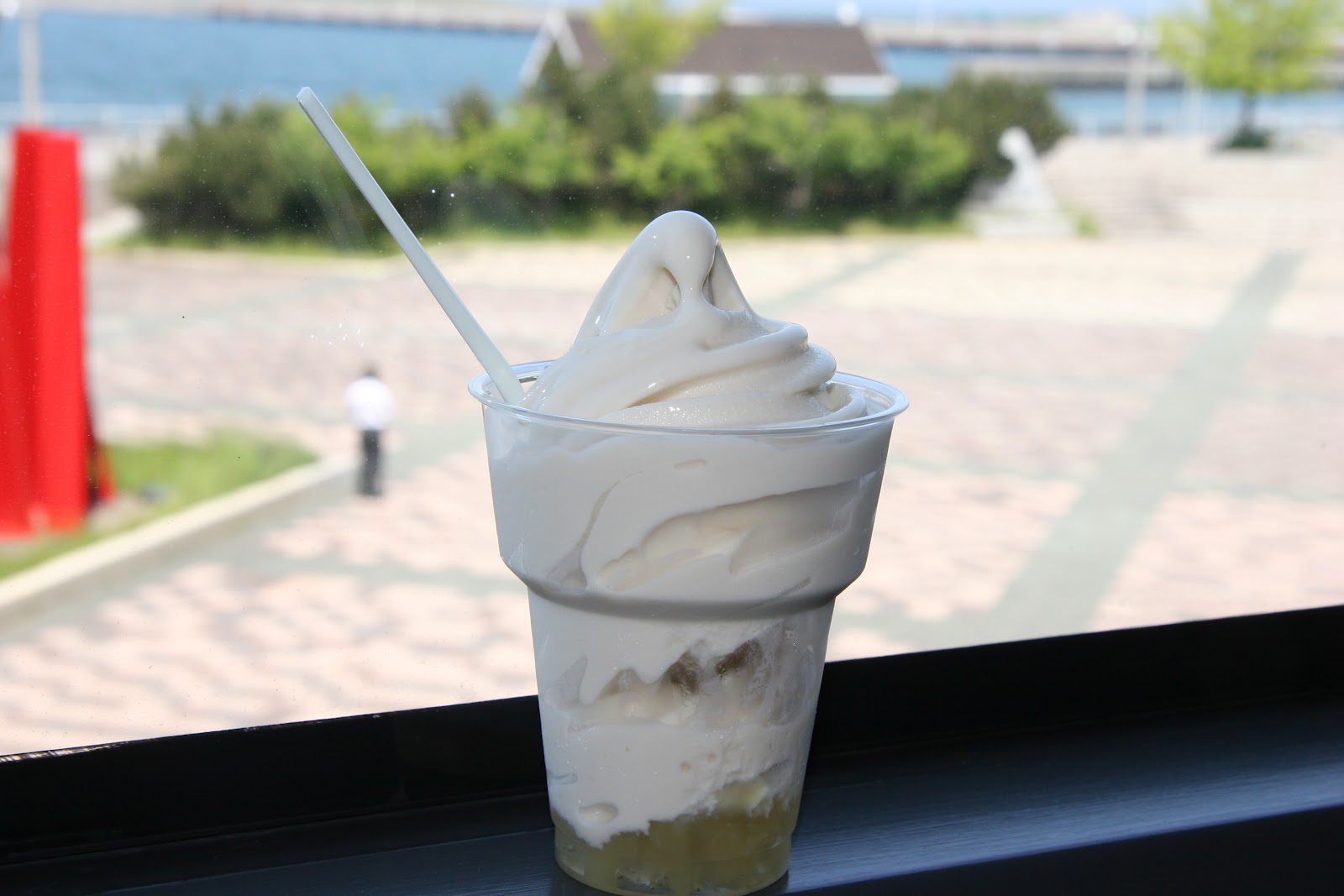
Apple Soft Ice Cream

Another soft ice cream.
At ASPAM, Aomori Prefecture Tourist Center, you can enjoy the taste of Aomori.
Aomori is quite famous for apples that more than half the apples produced in Japan come from Aomori. There are heaps of various apple products and this ice cream is one of them. It’s soft-served and vanilla and pure apple syrup taste, and chopped fresh apple at the bottom of the cup with apple syrup again. Needless to say, it's delicious!!


Besides apple ice cream, you can also try “scallop soft ice cream” at another shop in ASPAM. I’ve never tasted it before so that I can’t say it’s good or not. If you want to try, please drop in at ASPAM.

Aomori Sightseeing Guide "aptinet":  http://en.aptinet.jp/