10/18/2012

Morning Market in Hachinohe

There are about 10 official morning markets in Hachinohe, and I visited one of them which started in 1945 at JR Mutsuminato-Station.

I arrived around 6:30 after a 15-min. drive, and it was not that early to visit because the market opens before the sunrise. I was surprised to see many retailers and farmers open their own shops along the street for several hundred meters (I heard that there are usually more than 200 shops). I even found coffee shops.


Coffee shop!

Vienna coffee for 100 yen♪


Hachinohe is very famous for fishery, but there were not only seafood but also vegetables, fruits and flowers.


Dried flatfish

Dried squids

Hiratsumegani (Ovalipes punctatus)

This is Hachinohe Fish and Vegetable Retail Market in front of the station, and there are about 40 shops inside. You can buy either fresh or processed seafood, meat and daily dishes.


Dried herrings

Beautiful sauries

You can buy, take some fresh seafood and cook at home, but you can enjoy the taste of Hachinohe right after your purchase at this market.

Fatty tuna, cheap!
Saury fillet
You can buy cooked rice, miso soup and
other dishes such as grilled seafood,
salad, fried eggs and sausages.


It says "Japan's liveliest breakfast and
the proper way of eating".

On the left, assroted sashimi (raw fish).
Salmon, sea bream, tuna and squid.
You can make your own seafood bowl.

You can bring vegetables or fruits
from the shops outside.

After you enjoyed your breakfast at the market, go see the statue of "Isaba-no Kaccha". “Isaba” means fish shops or fish markets, and “kaccha” means women working in the market. She wears an apron, covers her cheeks with a handkerchief and holds a squid in her hand. This is a typical “Isaba-no Kaccha”.
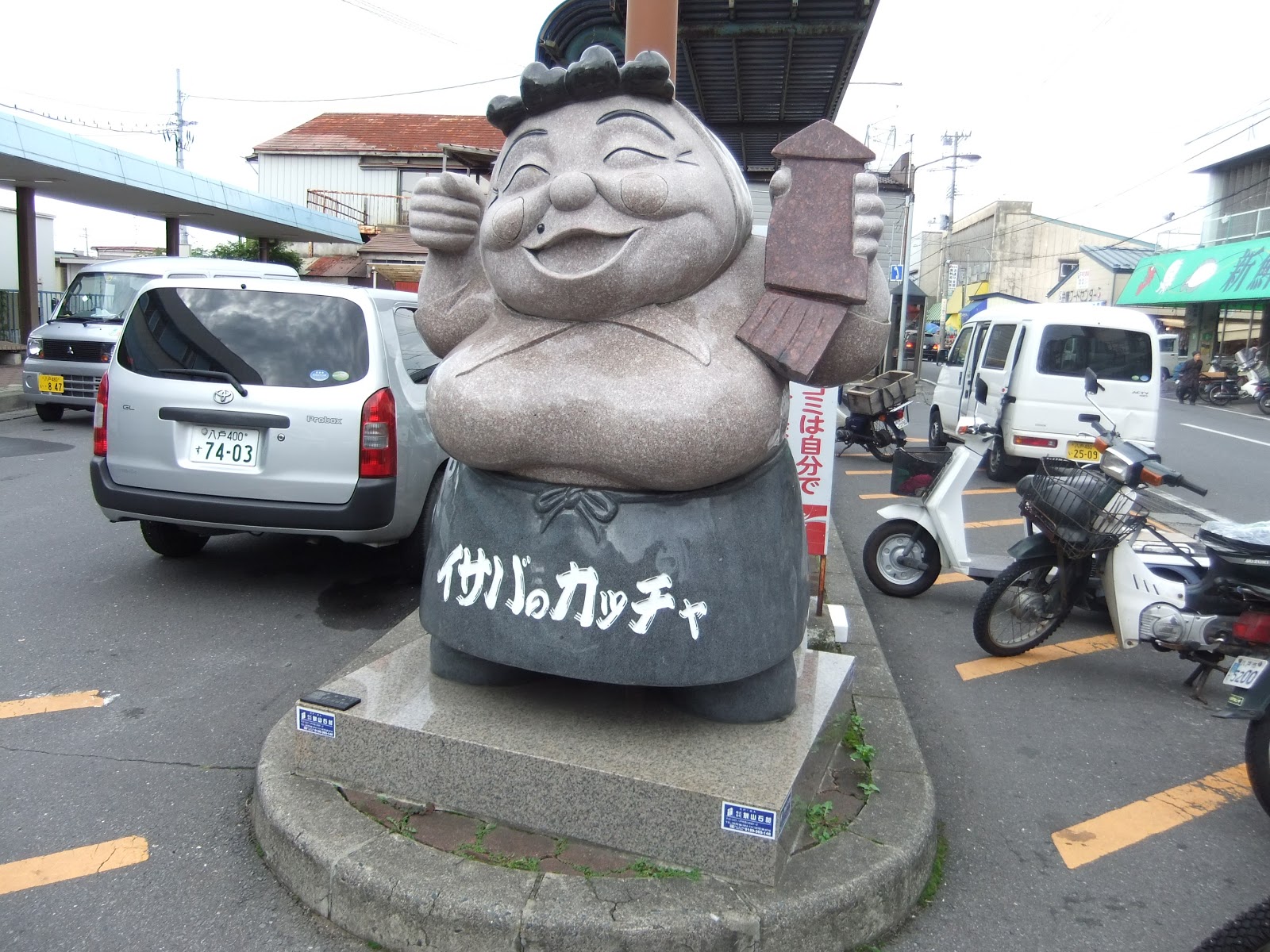

Very 3D.

If you have a plan to stay at the hotel in Hachinohe, you can take part in taxi tours called “Asaguru”. There’re 2 courses to enjoy morning time in Hachinohe. Tours depart from the hotels in the city central or the ones near JR Hachinohe Station.

1. Hotel – Morning market – Public bath – Hotel
    (departing at 6:00, approx. 2.5 hrs., 1,500 yen)
2. Hotel – Morning market – Hotel (departing at 7:00, 1,200 yen)

Those tours are run by Hachinohe Convention Bureau http://www.hachinohe-cb.jp/asaguru/index.html (Japanese only).

☆Aomori Sightseeing Guide "aptinet"  http://en.aptinet.jp/


Click to see larger map of Mutsuminato Morning Market

10/15/2012

Spring Water of Osorezan

Osorezan is well known as one of the three major holy sites or hallowed grounds in Japan and was established by Jikakutaishi of Tendai Buddhism in 862. It's located in the Shimokita Peninsula Quasi-National Park.

There’s an approach to Osorezan from the city central of Mutsu. On the way of 14km from the city to Osorezan, there’s spring water welling from the natural cypress forest.


You can drink this spring water, also called “spiritual water” or “ever-young water”, at the bus stop “Reisui (Cold water)”. The bus waits for few minutes while passengers who are going to Osorezan drink water (this stop service isn’t available for the bus of reverse direction).

Visitors (pilgrims) to Osorezen are to wash their hands, rinse the mouth to purify themselves here, and this place is said to be the border of the spirit world
and the secular world.


It takes about 30 min. to get to the bus stop "Reisui" from JR Shimokita Station and costs 750 yen. The bus service is not available from November 1 to April 30.


Aomori Sightseeing Guide “apti net” http://en.aptinet.jp/


Indicate Osorezan Cold Water in a larger map.

10/12/2012

Tsugaru Nuri (Lacquerware)


Tsugaru Nuri (Tsugaru Lacquerware) is a traditional and honorable artifact of Aomori which began to be produced at the end of the 17th century. Tsugaru Nuri is basically designed for daily use that almost every household in Tsugaru area has at least 1 piece of Tsugaru Nuri item.

Tsugaru Nuri uses cypress body with cloth winded, and it takes more than 40 hand-made processes to complete such as foundation making, whetting, lacquering and polishing. One proper item takes about 60 days to be completed.

The following photo shows some typical process of chopstick making.

Kara Nuri
Whetting layered lacquer with whetstone, sandpaper or
charcoal,and polishing after some more lacquer layer.

Nanako Nuri
It uses rape seeds for making patterns. While a lacquer
layer is still wet, seeds are spread on the surface,
and removed after a piece gets dried.
Luckily, I had an opportunity to experience one of the processes of making Tsugaru Nuri under the instruction of real Tsugaru Nuri craftsmen. What I experienced seemed the one in the photo above (Kara Nuri).

First of all, I was handed vermillion chopsticks. They looked that just vermillion lacquer was layered, but there lay more than 10 layers with patterns underneath.

I was to whet chopsticks with wet sandpaper. Not to damage the patterns, I had to whet very tenderly.


After whetting about 2 minutes, there appeared patterns from underneath.


I completed this process after about an hour, changing sandpapers three times gradually from the coarse one to the fine .

I have to wait for another 1 week to have my own chopsticks to be sent after real craftsman applies the additional finishing lacquer coatings followed by final surface polishing.

This opportunity was carried out in the exhibition of Tsugaru Nuri, and if you’d like to try, please refer to the following places.

“Tsugaru Traditional Art and Craft Store” from aptinet

Tsugaru Neputa-mura Village” from aptinet

☆Aomori Sightseeing Guide “aptinet”  http://en.aptinet.jp/


8/10/2012

Aomori Nebuta Festival

Aomori Nebuta Festival is one of three largest festivals in Tohoku region. More than 20 illuminated floats parade at night on the main streets in Aomori City.
The festival is held annually, from July 2nd to 7th (it’s held during daytime on the last day), and there’re always about 3 million (population of Aomori City is about 300 thousands) spectators from inside and outside of Aomori, even from overseas.
Nebuta Festival is designated as a National Important Intangible Folk Cultural Property.

This festival is so famous that many people might have seen it through various kinds of media, but I think, living in Aomori, I’m lucky to see not only the festival itself but also the process of making a float.


1. Concept and rough sketch
The idea of nebuta is usually based on historical stories, myths and legends, sometimes kabuki stories are also adopted. A producer takes quite a long time to draft as the sketch is like a design drawing.


2. Putting up a hut
A hut is required for making nebuta and for storage. Frontage: approx. 12m, depth: approx. 12m, height: approx. 6~7m


3. Preparation of the details
Details like face, hands, feet, sword and spear are made beforehand. Size of the parts is calculated by proportional expression. Making those details continues until just before a hut is built.


I traced the eyes, nose and face on the photo.
 
4. Framework
Making the structure starts with making pillars of square timbers, and then outlines are formed with wires and threads. Bamboo used to be used until 1950s.


5. Electric wiring (lighting)
Candles were used inside nebuta for lighting before, but nowadays, about 1000 electric lights are used with power source from a generator. These days, LED is becoming popular for lighting.


6. Pasting papers
Japanese papers are pasted on the frames. Bond for woodworking is used, and it’s difficult not to put bond beyond the border of the frames. After completing this procedure, it becomes more like nebuta.

My co-worker Kyu-san tried pasting papers.


Professional!


7. Kakiwari (inking the outlines of the structure)
Faces, collar, belt and patterns of kimono (clothes) are to be framed with black ink. Inking is very important to bring about energy and force of nebuta.


8. Wax drawing
Wax drawing is another important procedure to deepen expressions of nebuta with melted paraffin wax. It brightens up nebuta and also prevents running of the color paints.


9. Coloring
To color remaining white area, dye-ink and water pigment are used with brushes and spray bottles.


10. Putting up to a stand
About 40 - 50 people are required to put up nebuta to the stand with wheels. Height of the whole float is approximately 5m.


Background and ASPAM

Generator underneath

11. This is it.
It still needs more decorations for the stand, but this is nebuta.


The Festival this year is finished, but you still get information for next year.
Aomori Nebuta Festival Official Homepage: http://www.atca.info/nebuta_en/

Aomori Sightseeing Guide "aptinet": http://en.aptinet.jp/

8/09/2012

People to People Student Ambassador in Aomori – 03

On the fourth day of their stay in Aomori Prefecture, the delegation left their homestay families in Hirakawa. All of them had good families that they wailed because of sadness as they departed (see the photo from the local bulletin in the previous article - 01).

After arriving in Aomori City, they visited the Prefectural Office to make a courtesy call on the vice governor of Aomori. They told the vice governor how they enjoyed their stay in Hirakawa and loved the host families, sceneries, food, people and every single experience.

The vice governor said that he wants them to lead to promote international understanding and friendship through experiences in Aomori.
 

The delegation and Aomori Prefecture exchanged the gifts, a Tsugaru lacquer ware (Tsugarunuri) to the delegation and a hand-made Native American blanket to Aomori Prefecture. The blanket was supposed to be handed last year, but because of the Earthquake, the program was cancelled that students couldn’t come to Japan.

After receiving an official welcome, they visited Aomori Minami High School. They were enthusiastically welcomed that despite of a short time visit, both American and Japanese students became good friends.


They were off to Lake Towada, the last place to visit in Aomori. After staying an overnight at Lake Towada, they'd go to Hiraizumi which is the area of World Heritage Site in Iwate Prefecture.

The students seemed to enjoy their stay in Aomori that they said they want to come back one day.

I spent with them only for a few days, but I loved them a lot and I hope they’d never forget their experiences in Aomori.

PEOPLE TO PEOPLE AMBASSADOR PROGRAMS: http://peopletopeople.com/

Aomori Sightseeing Guide "aptinet": http://en.aptinet.jp/