12/19/2012

Nara Yoshitomo's Exhibition

The exhibition "NARA Yoshitomo : a bit like you and me..." is being held at Aomori Museum of Art.

Unfortunately, taking pictures of his works is prohibited, but I'll upload some other pictures instead.

At the entrance gate


Aomori-Ken


Handmade cap


At the shop


Chocolates☆


Besides the main entrance.


Ticket tub


Flyer

List of works

Another exhibition being held
at Towada Art Center

Aomori Museum of Art http://www.aomori-museum.jp/en/
Towada Art Center http://towadaartcenter.com/web/top.html
Aomori Sightseeing Guide "aptinet" http://en.aptinet.jp/

Hachinohe Mackerel

Hachinohe City is located at the east coast of Aomori Prefecture, and it’s famous for fishery such as squids and mackerel. Especially mackerel is getting more popular than ever.


Secrets of Off Hachinohe Mackerel

1. The northernmost fishing point for mackerel
Latitude of the fishing point off Hachinohe is 40° 30’, and it’s the northernmost point in Japan. Mackerel caught only in this area is treated as “Off Hachinohe Mackerel”.

2. Low seawater temperature
Mackerel is said that its crude fat increases when seawater temperature goes below 18℃. The water of the fishing point off Hachinohe drastically becomes cool around September every year.

3. Rich in crude fat
A mackerel caught off Hachinohe and of more than 600g often includes 30% of crude fat, and even smaller one with weight of 400g has more than 15% fat. According to Standard Tables of Food Composition in Japan, the average amount of the crude fat of a mackerel is 12.1%, and it shows how rich fat Hachinohe mackerel has.
Because of the crude fat, Hachinohe mackerel leaves better aftertaste than the one from Northern Europe.

4. Rich in unsaturated fatty acid
Crude fat contains rich unsaturated fatty acid called EPA and DHA which are essential fatty acid for human body, and our body cannot make them itself. Hachinohe Mackerel helps you take these acids.

5. Neighboring fishing point offers you fresh mackerel
Mackerel is very perishable, but the fishing point of Hachinohe Mackerel is only several kilometers away from Hachinohe Port that mackerel is landed freshly keeping good taste.

The followings are what I had at "Saba-no Eki" (Mackerel Station) where you can eat your fill of premium mackerel.


Skewered mackerel and mackerel ball on the left,
and sashimi on the right.


Mackerel slice simmered in miso
(with cheese as a secret ingredients)


(Left) soy sauce marinated
(Right) preserved in miso


With chopped green onion, sprinkled sesame
seeds and red pepper on top.


Slightly roasted.


Rod-shaped mackerel sushi
and senbei-jiru.


Using salted and vinegared mackerel.


Senbei-jiru is salt broth with vegetables,
fish (mackerel in this dish) and
cracked senbei (flour cracker).
 

Saba-no Eki: 1st floor, Daimatsu Building
                   12 Muikamachi, Hachinohe City
                   031-0033 Aomori Prefecture
                   TEL 0178-24-3839

Aomori Sightseeing Guide "aptinet" http://en.aptinet.jp/


View Saba-no Eki in a larger map

10/26/2012

Beautiful Sunset

A day of fine weather in autumn shows us such a beautiful sunset, and this is it.
Mt. Iwaki on the left and Aomori Bay Bridge on the right.
This photo was taken at the observatory in ASPAM, Aomori Prefecture Tourist center.


Aomori Sightseeing Guide "aptinet"  http://en.aptinet.jp/


View ASPAM in a larger map.

10/18/2012

Morning Market in Hachinohe

There are about 10 official morning markets in Hachinohe, and I visited one of them which started in 1945 at JR Mutsuminato-Station.

I arrived around 6:30 after a 15-min. drive, and it was not that early to visit because the market opens before the sunrise. I was surprised to see many retailers and farmers open their own shops along the street for several hundred meters (I heard that there are usually more than 200 shops). I even found coffee shops.


Coffee shop!

Vienna coffee for 100 yen♪


Hachinohe is very famous for fishery, but there were not only seafood but also vegetables, fruits and flowers.


Dried flatfish

Dried squids

Hiratsumegani (Ovalipes punctatus)

This is Hachinohe Fish and Vegetable Retail Market in front of the station, and there are about 40 shops inside. You can buy either fresh or processed seafood, meat and daily dishes.


Dried herrings

Beautiful sauries

You can buy, take some fresh seafood and cook at home, but you can enjoy the taste of Hachinohe right after your purchase at this market.

Fatty tuna, cheap!
Saury fillet
You can buy cooked rice, miso soup and
other dishes such as grilled seafood,
salad, fried eggs and sausages.


It says "Japan's liveliest breakfast and
the proper way of eating".

On the left, assroted sashimi (raw fish).
Salmon, sea bream, tuna and squid.
You can make your own seafood bowl.

You can bring vegetables or fruits
from the shops outside.

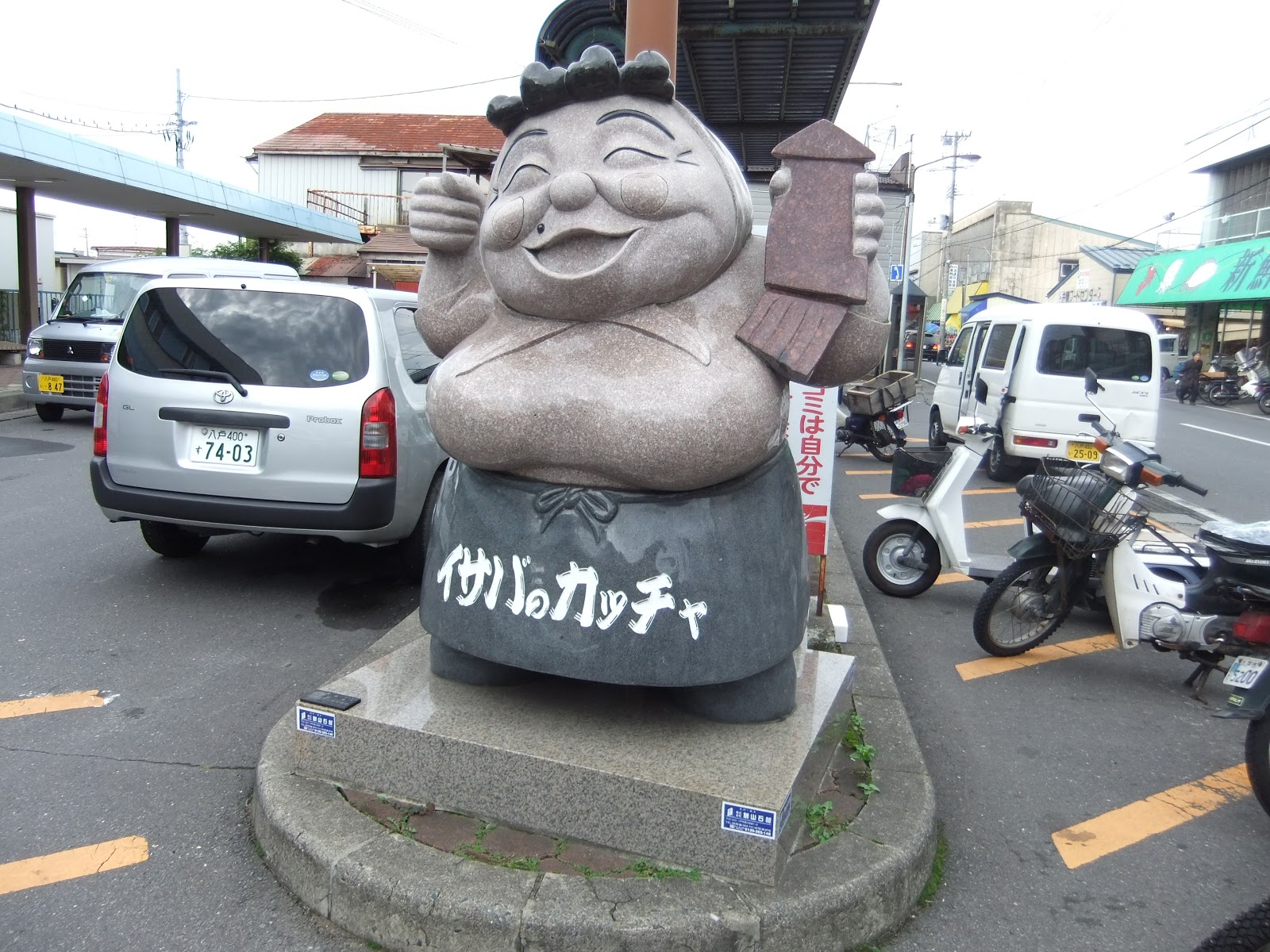
After you enjoyed your breakfast at the market, go see the statue of "Isaba-no Kaccha". “Isaba” means fish shops or fish markets, and “kaccha” means women working in the market. She wears an apron, covers her cheeks with a handkerchief and holds a squid in her hand. This is a typical “Isaba-no Kaccha”.


Very 3D.

If you have a plan to stay at the hotel in Hachinohe, you can take part in taxi tours called “Asaguru”. There’re 2 courses to enjoy morning time in Hachinohe. Tours depart from the hotels in the city central or the ones near JR Hachinohe Station.

1. Hotel – Morning market – Public bath – Hotel
    (departing at 6:00, approx. 2.5 hrs., 1,500 yen)
2. Hotel – Morning market – Hotel (departing at 7:00, 1,200 yen)

Those tours are run by Hachinohe Convention Bureau http://www.hachinohe-cb.jp/asaguru/index.html (Japanese only).

☆Aomori Sightseeing Guide "aptinet"  http://en.aptinet.jp/


Click to see larger map of Mutsuminato Morning Market

10/15/2012

Spring Water of Osorezan

Osorezan is well known as one of the three major holy sites or hallowed grounds in Japan and was established by Jikakutaishi of Tendai Buddhism in 862. It's located in the Shimokita Peninsula Quasi-National Park.

There’s an approach to Osorezan from the city central of Mutsu. On the way of 14km from the city to Osorezan, there’s spring water welling from the natural cypress forest.


You can drink this spring water, also called “spiritual water” or “ever-young water”, at the bus stop “Reisui (Cold water)”. The bus waits for few minutes while passengers who are going to Osorezan drink water (this stop service isn’t available for the bus of reverse direction).

Visitors (pilgrims) to Osorezen are to wash their hands, rinse the mouth to purify themselves here, and this place is said to be the border of the spirit world
and the secular world.


It takes about 30 min. to get to the bus stop "Reisui" from JR Shimokita Station and costs 750 yen. The bus service is not available from November 1 to April 30.


☆Aomori Sightseeing Guide “apti net” → http://en.aptinet.jp/


Indicate Osorezan Cold Water in a larger map.

10/12/2012

Tsugaru Nuri (Lacquerware)


Tsugaru Nuri (Tsugaru Lacquerware) is a traditional and honorable artifact of Aomori which began to be produced at the end of the 17th century. Tsugaru Nuri is basically designed for daily use that almost every household in Tsugaru area has at least 1 piece of Tsugaru Nuri item.

Tsugaru Nuri uses cypress body with cloth winded, and it takes more than 40 hand-made processes to complete such as foundation making, whetting, lacquering and polishing. One proper item takes about 60 days to be completed.

The following photo shows some typical process of chopstick making.

Kara Nuri
Whetting layered lacquer with whetstone, sandpaper or
charcoal,and polishing after some more lacquer layer.

Nanako Nuri
It uses rape seeds for making patterns. While a lacquer
layer is still wet, seeds are spread on the surface,
and removed after a piece gets dried.
Luckily, I had an opportunity to experience one of the processes of making Tsugaru Nuri under the instruction of real Tsugaru Nuri craftsmen. What I experienced seemed the one in the photo above (Kara Nuri).

First of all, I was handed vermillion chopsticks. They looked that just vermillion lacquer was layered, but there lay more than 10 layers with patterns underneath.

I was to whet chopsticks with wet sandpaper. Not to damage the patterns, I had to whet very tenderly.


After whetting about 2 minutes, there appeared patterns from underneath.


I completed this process after about an hour, changing sandpapers three times gradually from the coarse one to the fine .

I have to wait for another 1 week to have my own chopsticks to be sent after real craftsman applies the additional finishing lacquer coatings followed by final surface polishing.

This opportunity was carried out in the exhibition of Tsugaru Nuri, and if you’d like to try, please refer to the following places.

“Tsugaru Traditional Art and Craft Store” from aptinet

“Tsugaru Neputa-mura Village” from aptinet

☆Aomori Sightseeing Guide “aptinet”  http://en.aptinet.jp/